

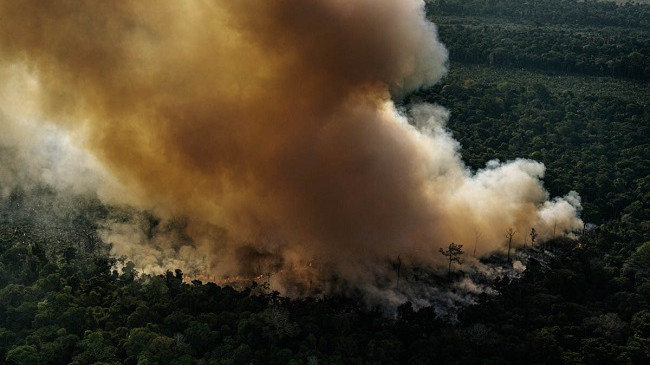
Sipas Institutit Kombëtar për Kërkime në Hapësirë (INPE), numri i zjarreve të pyjeve në Amazon këtë vit u rrit për 84 për qind në krahasim me vitin 2018.
Rajonin perëndimor i Rondonias duket së është një nga më të shpyllëzuarit dhe me shfrytëzimin e madh të tokës.
Në gusht, Presidenti Jair Bolsonaro, pa prova, fajësoi OJQ-të që punojnë për zjarret.
Ndërkohë, aktivistët e mjedisit denoncuan rrëmbyesit e tokave, fermerët dhe ndërmarrjet e agrobiznesit Amazonian, të mbështetur nga retorika e qeverisë, për zjarr-vënieve të pyjeve dhe shfrytëzimin e tokave.
Parcelat e tokave janë të kultivuar pothuajse me monokulturë soje ose ushqim të kafshëve për bagëti kullotëse. Biznesi i sojës dhe ushqim i kafshëve për bagëtitë intensive, është në duart e disa ndërmarrjeve të mëdha, është bërë një nga më fitimprurëset në botë.
"Në emër të zhvillimit, ekziston një zbatim i politikave më pak kufizuese për shfrytëzimin e tokave Amazoniane, duke legjitimuar kështu rritjen e shpyllëzimit", tha Neidinha, i cili drejton një organizatë që punon me grupe indigjene në Rondonia për të mbrojtur mjedisin.
Inkuadrimet në territoret indigjene janë rritur gjithashtu, sipas anëtarëve të fiseve Karitiana dhe Uru-Eu-Wau-Wau.
Juripe, kryetar i fshatit Jamari, tha se në Shtator, një grup grabitësish të tokave janë kapur duke ua vënë zjarrin pyjeve të tyre, të cilët janë identifikuar dhe arrestuar.
"Megjithëse fiset indigjene janë të vetmit që janë në gjendje të jetojnë nga burimet natyrore, prerësit e pyjeve dhe rrëmbyesit e tokave kanë shfrytëzuar rregullit tokat dhe pyjet tona për përfitime", tha Juripe. /Motilokal.com
![Purua, 45, of the Uru-Eu-Wao-Wao tribe, set fire to a land grabbers' hut inside his tribe's reserve. In September 2019, a group of land-grabbers that deforested the territory was intercepted by the Funai (government agency for the protection of indigenous people) and arrested by police inside the Uru-Eu-Wao-Wao reserve. A group from Purua's tribe returned to the scene to set fire to the illegal hut so they can not return. [Fabio Bucciarelli/Al Jazeera]](https://www.aljazeera.com/mritems/Images/2019/10/21/6b20a8b992d14ed2bf7bed0d480b54cb_8.jpg)
![Juripe, the village chief of the Aldea Jamarì, walks in a forest destroyed by land-grabbers who burned the indigenous area to claim the land and make it cultivable. On September 26, Juripe led a mission to destroy an illegal hut in the forest used as a base by land-grabbers to deforest the area. [Fabio Bucciarelli/Al Jazeera]](https://www.aljazeera.com/mritems/Images/2019/10/21/c0786ee6ffd744dca6d55ae0396f9a81_8.jpg)
![Jelson stands in front of his cassava field burned due to fires in a neighbouring forest in the province of Porto Velho. [Fabio Bucciarelli/Al Jazeera]](https://www.aljazeera.com/mritems/Images/2019/10/21/0991054aba3d468d8c9e4d242a8092c0_8.jpg)
![The remains of a house belonging to Jeovaldo in the indigenous territory of the Karitiana tribe, Central Aldea, Rondonia. The house caught fire due to a blaze in a neighbouring forest. Private farms surrounding the indigenous territory threaten the Karitians and the forest. [Fabio Bucciarelli/Al Jazeera]](https://www.aljazeera.com/mritems/Images/2019/10/21/f50fb0d9502b470190fef9d1c227ab8f_8.jpg)
![Fishermen under a bridge that crosses the Madeira River in Porto Velho. In the background, silos are used to store soya, which is among the world's most cultivated food products. [Fabio Bucciarelli/Al Jazeera]](https://www.aljazeera.com/mritems/Images/2019/10/21/d2996c8741af49bfa7d11cf07265a851_8.jpg)
![An area of forest that has become cattle pasture near Porto Velho. The beef trade is one of the most profitable businesses in the country and the need for grazing land is one of the main causes of deforestation. The process begins with the theft of the best wood for illegal sale and the ground is subsequently set on fire. Once the land is cleared, the forest is used to graze cattle and then grow soya. [Fabio Bucciarelli/Al Jazeera]](https://www.aljazeera.com/mritems/Images/2019/10/21/6f2d8e4a26f44799a7efb898cb8b2485_8.jpg)
![The manager and a veterinarian at the Frigo 10 slaughterhouse in Porto Velho, Rondonia. The beef trade is one of the most profitable activities in the country. [Fabio Bucciarelli/Al Jazeera]](https://www.aljazeera.com/mritems/Images/2019/10/21/ab174cd1c14d47a8a940ef799b3300b3_8.jpg)
![Karitian indigenous tribespeople in the central aldea of their indigenous territory in Rondonia. Private farms surrounding the indigenous territory threaten the Karitians and the forest. [Fabio Bucciarelli/Al Jazeera]](https://www.aljazeera.com/mritems/Images/2019/10/21/8ac90587c9d140448881b784a1e72ec7_8.jpg)
![Mayte 32, Purua, 45, and Alessandra, 27, from the Uru-Eu-Wau-Wau indigenous tribe in their Amazon reserve. On September 26, the three took part in a mission in the forest to reach an illegal hut used as a base by land-grabbers who set fire to neighbouring forest.[Fabio Bucciarelli/Al Jazeera]](https://www.aljazeera.com/mritems/Images/2019/10/21/77f0c3a2e0174ceaa1a6c7159960daac_8.jpg)
![Smoke rises from fires near Porto Velho, Rondonia, Brazil. [Fabio Bucciarelli/Al Jazeera]](https://www.aljazeera.com/mritems/Images/2019/10/21/67e2fe365e7e4b4ebc624ba2a961f7fd_8.jpg)
![Workers near Jaci Parana in the Rondonia region. The theft and illegal movement of Amazonian wood represents 30 percent of the global market. In the process of deforestation, before setting the forest on fire, land-grabbers cut the finest trees to sell on the black market. [Fabio Bucciarelli/Al Jazeera]](https://www.aljazeera.com/mritems/Images/2019/10/21/5ff6541ee8b54e988b740bc6d412e77b_8.jpg)
![A fire in the province of Porto Velho in Rondonia, Brazil, one of the most deforested parts of the Amazon. [Fabio Bucciarelli/Al Jazeera]](https://www.aljazeera.com/mritems/Images/2019/10/21/8d064e1e452e4e72b294e872915a52fa_8.jpg)
![A fire in Porto Velho in Rondonia. [Fabio Bucciarelli/Al Jazeera]](https://www.aljazeera.com/mritems/Images/2019/10/21/8bb83a948cda46b4af0b4f5d72a0cbc4_8.jpg)





